City Know-hows
Our research highlights how some groups in London, like children, ethnic minorities, and lower-income residents, experience hotter areas due to the Urban Heat Island effect. We provide a clear approach for local governments to make climate action fairer and more effective.
Share
Target audience
City planners, public health officials, and community leaders working on climate change and urban development. Especially those focused on making cities more resilient and ensuring that climate actions reach the most vulnerable populations.
The problem
In cities like London, paved surfaces and buildings trap heat, making some areas significantly warmer. This ‘Urban Heat Island’ effect hits certain groups harder—like children, low-income families, and ethnic minorities—who live in hotter neighbourhoods. This puts their health and mobility at greater risk, particularly during heatwaves. While there are efforts to cool cities, they often miss the most affected areas, leading to deeper inequalities in who benefits from these climate interventions.
What we did and why
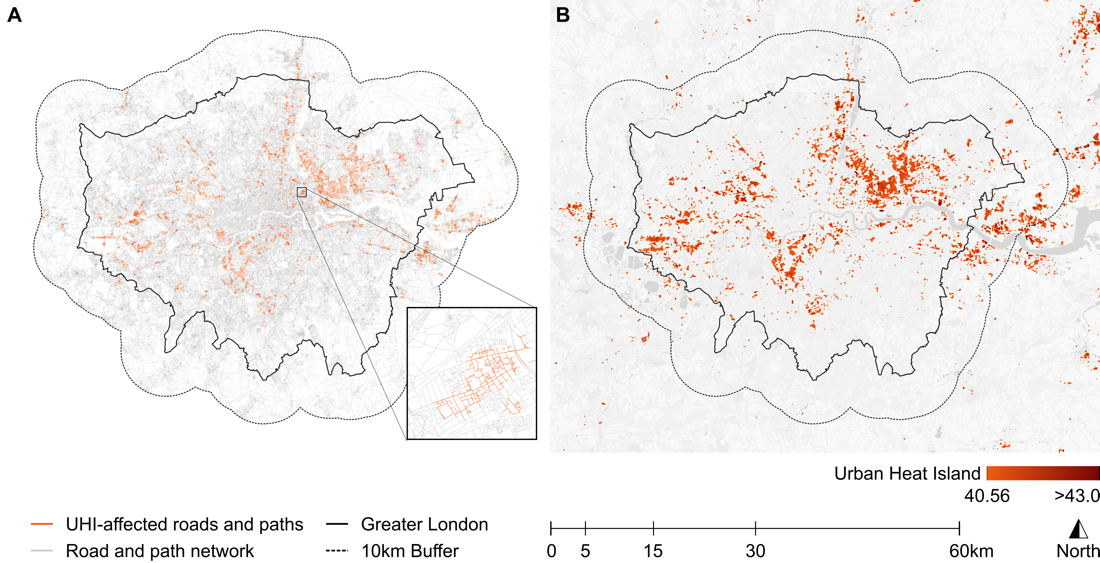
We studied how different communities in London are exposed to higher temperatures due to the Urban Heat Island effect. We combined satellite data with census information and used a unique method to see how these heat effects reduce people’s ability to move around their neighborhoods. Our aim was to give city leaders a clearer picture of where help is needed most so they can take action to make all areas, especially those most at risk, cooler and healthier.
Our study’s contribution
Our study provides new insights into how extreme heat affects different communities in London and offers practical steps for city leaders. We show:
• How heat exposure is unevenly distributed across various socio-economic and ethnic groups in London.
• A novel method for understanding how high temperatures reduce people’s ability to move around their neighbourhoods.
• Practical guidance for local governments to focus street-level interventions in the areas most affected, ensuring resources reach those who need them most.
Impacts for city policy and practice
Our findings highlight the need for targeted, equitable climate actions in London. We recommend that city officials:
• Prioritise cooling interventions in areas where vulnerable groups—such as children, lower-income families, and ethnic minorities—are most affected.
• Increase urban greenery and install cooling infrastructure, like shaded areas and water features, to alleviate heat in these hotspots.
• Consider heat impacts on daily life and mobility when planning streets and public spaces, to create healthier, more liveable environments.
Further information
Full research article:
Urban heat island effect: examining spatial patterns of socio-demographic inequalities in Greater London by Kimon Krenz & Luisa Amann
Related posts

Our study sheds light on the evolving dynamics of the Greater Cairo Region, adding depth to the understanding of whether gated communities act as true remedies or reflections of concrete houses. By incorporating a model based on critical factors for mental health, we offer insights into the nuanced dimensions of well-being in the context of urban development. This research contributes to a more comprehensive understanding of the complex interplay between city structure and residents’ overall well-being.

We wanted to understand the types of gardening for wildlife taking place in London’s private gardens and the influence of demographic factors on the likelihood to garden for wildlife. We sent out a digital questionnaire to ask Londoners about their gardening for wildlife practices and their age, gender, ethnicity, religious beliefs, occupation, household income, accommodation type, home ownership status, garden type, shared garden or not, dependents, and conservation-organisation membership status.

Understanding decision-making for active living infrastructure in a middle-income country: Aspirations and pressures for development may not support creation of good quality walking and cycling