City Know-hows
We propose a replicable spatial framework applied at the small geographic scale in Pisa, Italy, to address a methodological gap. We find that both a Composite Vulnerability Index and density predict excess mortality, providing an essential tool for health equity planning.
Share
Target audience
Municipal health departments, urban planners, and public health officers working in mid-sized cities internationally. Our
methodology is also intended for Local Community Leaders and Advocacy Groups globally.
The problem
We observe that neighbourhood-level health data are consistently underutilized, masking critical geographic disparities and their impact on urban mortality. Health inequalities are rooted in the inequitable distribution of socio-demographic determinants, exposing specific communities to a greater risk of adverse outcomes. To tackle this challenge and bridge the evidence-to-policy gap, we urgently require a robust framework capable of producing disaggregated, small-scale data that directly informs local governance and targeted interventions.
What we did and why
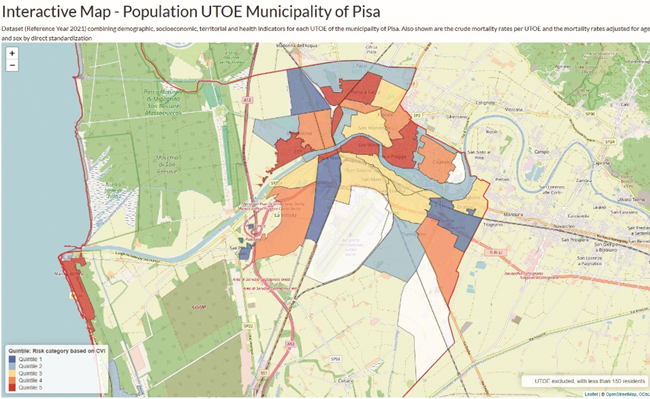
We proposed and validated a spatial epidemiological framework to quantify neighbourhood health disparities in Pisa, Italy. We created a Composite Vulnerability Index (CVI) via Principal Component Analysis, aggregating key socioeconomic factors. We linked this Composite Vulnerability Index to georeferenced mortality data and used Spatial Autoregressive models to test their association. This approach generates planning-actionable evidence at a small geographic scale, essential for supporting effective, targeted interventions.
Our study’s contribution
Our study provides a practical, replicable spatial framework for analyzing health inequalities at a small geographic scale. Crucially, we demonstrate that both the Composite Vulnerability Index (CVI) and population density are strong and significant predictors of excess mortality in urban areas, with density emerging as the strongest. We mapped specific hotspots, generating actionable, fine-scale evidence to support equitable urban governance and targeted public health interventions in Italian and international cities.
Impacts for city policy and practice
We want to reach municipal health departments, urban planners, and public health officers working in mid-sized cities internationally. These professionals are the direct policy-makers who play a key role in integrating local socio-demographic data into policies aimed at reducing urban health disparities. The methodology is also intended for Local Community Leaders and Advocacy Groups globally, as the fine-scale data empowers them to demand evidence-based resource allocation, thus promoting health equity and active engagement with city governance at the neighborhood level.
This work directly supports local decision-makers by providing actionable evidence. We recommend prioritizing vulnerable neighborhoods identified by the Composite Vulnerability Index for outreach and preventive services. The graphic visualization of hotspots enables rapid communication and consensus building for resource allocation. Integrating the population density finding is key: planners must adjust urban design to mitigate associated mortality risks, fostering equitable and responsive city governance.
Further information
Full research article:
Visualizing neighbourhood health disparities: spatial epidemiology to map social vulnerability and mortality in an Italian city by Gabriele Donzelli, Michele De Nes, Paola Vivani, Francesco Sera and Nunzia Linzalone
Related posts

Health arguments are rarely used to justify urban policies in Latin America. A new urban health study suggests we can and should do better connecting

I use the travelogue methodology to investigate urban health and sustainable development in relation to the Mekong River in northeastern Thailand, revealing new insights and bringing travel to urban areas near the river into knowledge production.

Dystopian frameworks portend the future. With climatic upheavals increasing, dystopia is now. Because of escalating urban heat and heat-related illness and death, this essay speculates a future that switches daily activities into the coolness of night: Noctopia.