
City Know-hows
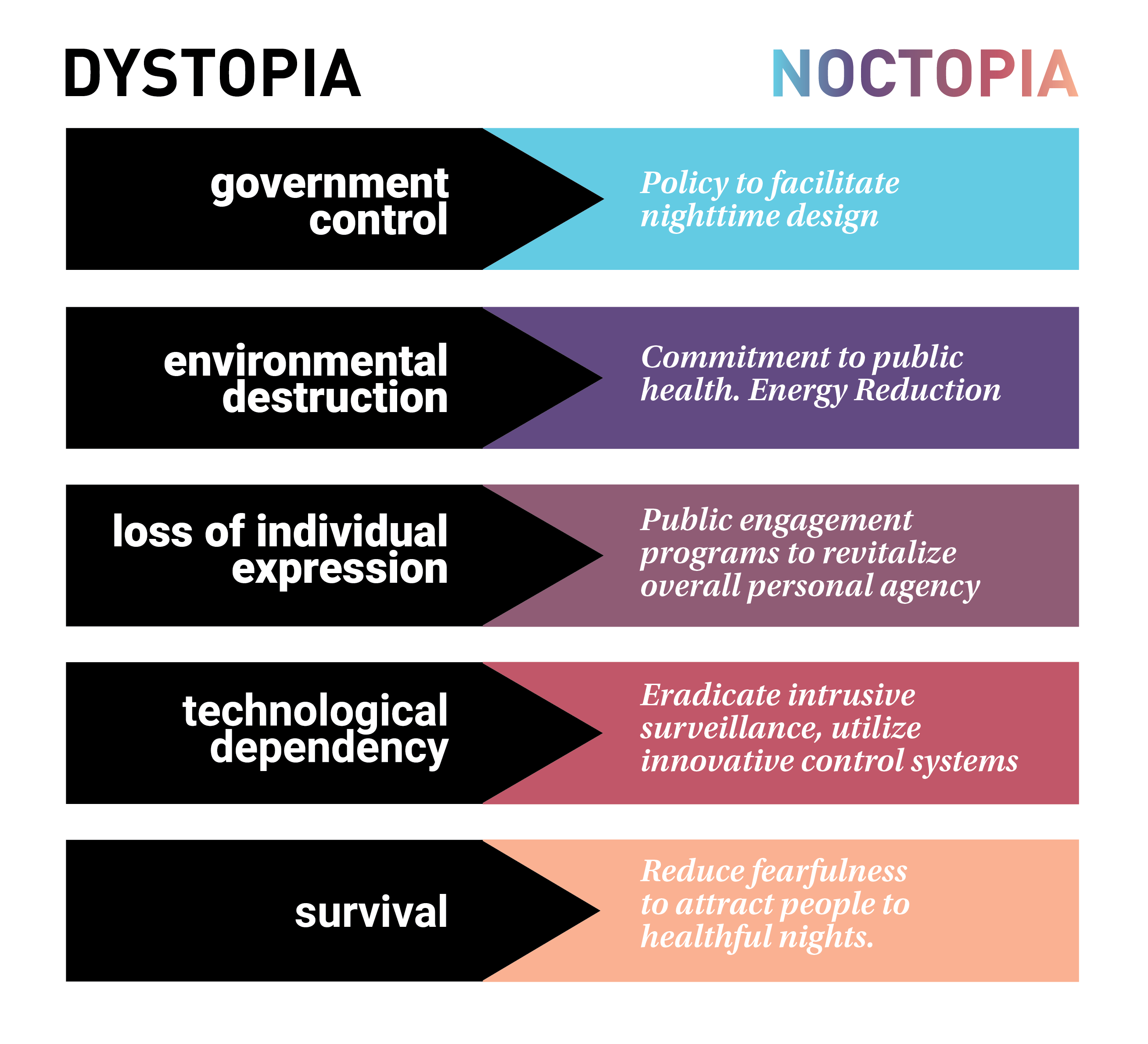
Dystopian frameworks portend the future. With climatic upheavals increasing, dystopia is now. Because of escalating urban heat and heat-related illness and death, this essay speculates a future that switches daily activities into the coolness of night: Noctopia.
Share
Target audience
Urban Planners, Civic leaders, Health and city policy makers
The problem
As long as the earth encircles the sun and urban heat escalates, nighttime matters as a space and time for respite.
However, our nights are undesigned and neglected. And are not fit for “daily” consumption.
This manifesto posits a kind of revolutionary adaptation–a switch up of night for day. Here, we contemplate: Is it possible to transform negative impressions of darkness by designing optimistic spaces after sunset?
What we did and why
I am a hybrid professional urban lighting/nighttime designer. Public space after dark has been my site for more than a decade. My research group and I have identified cases where work and play are shifting to the dark hours. I strongly believe that that shift will continue. My point to climate change activists and city-makers is that we need, now, to embrace nighttime design.
Our study’s contribution
This study adds cases where work and play scenarios have moved to night – with in humane, undesigned environments such as glary lighting and lack of services.
A utopian/Noctopian vision is posited with community-engaged design combined with technologically enabled, adaptive lighting. For example, in Noctopia, the library is open at midnight; luminous benches provide safe respite. Late-night closings thrive in midweek, especially along the transit corridor. A night market is open around the corner. Posters are up for a midnight concert at the local park, with provisions for audio headsets to coexist with the residential district.
Impacts for city policy and practice
Nighttime design is a new discipline or approach that is gaining traction. However, liveable nighttime environments are unevenly considered throughout the world’s cities. Lighting, urban design, and tech areas are implicated. And therefore, a multiplicity of city agencies are involved with holistic nighttime design… …unbeknownst to them! Example city departments include:
• Public works
• Urban planning and design
• Cultural agencies
• Building departments
• Climate change or heat specialities
• Public health
• And rarely, but growing, nightlife divisions
Further information
Full research article:
Night for Day by Leni Schwendinger
Related posts

Our research highlights how some groups in London, like children, ethnic minorities, and lower-income residents, experience hotter areas due to the Urban Heat Island effect. We provide a clear approach for local governments to make climate action fairer and more effective.

Residential segregation by socioeconomic status in Chilean cities is not well described by classical dimensions developed in USA in terms of race. We suggest that

This study aimed to delve into the significance of neighborhood walkability and the accessibility of third places in bolstering community well-being. It scrutinized the influence of walkable designs and convenient access to third places on the emotional well-being of community members. Moreover, the research utilized tweets to gauge the frequency of positive sentiments as a proxy for measuring happiness levels within the community.