
City Know-hows
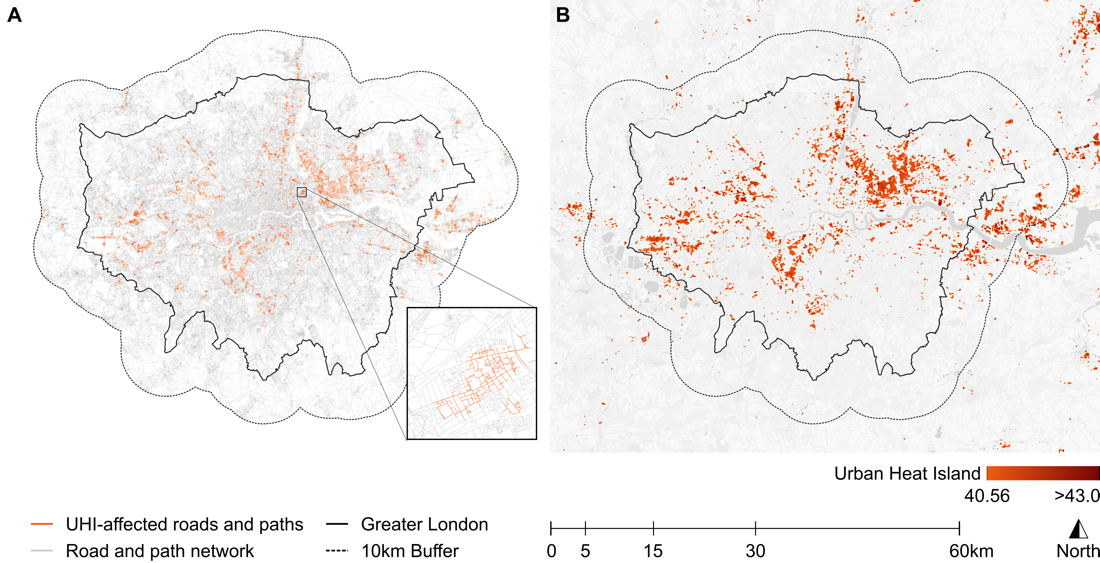
Our research highlights how some groups in London, like children, ethnic minorities, and lower-income residents, experience hotter areas due to the Urban Heat Island effect. We provide a clear approach for local governments to make climate action fairer and more effective.
Share
Target audience
City planners, public health officials, and community leaders working on climate change and urban development. Especially those focused on making cities more resilient and ensuring that climate actions reach the most vulnerable populations.
The problem
In cities like London, paved surfaces and buildings trap heat, making some areas significantly warmer. This ‘Urban Heat Island’ effect hits certain groups harder—like children, low-income families, and ethnic minorities—who live in hotter neighbourhoods. This puts their health and mobility at greater risk, particularly during heatwaves. While there are efforts to cool cities, they often miss the most affected areas, leading to deeper inequalities in who benefits from these climate interventions.
What we did and why
We studied how different communities in London are exposed to higher temperatures due to the Urban Heat Island effect. We combined satellite data with census information and used a unique method to see how these heat effects reduce people’s ability to move around their neighborhoods. Our aim was to give city leaders a clearer picture of where help is needed most so they can take action to make all areas, especially those most at risk, cooler and healthier.
Our study’s contribution
Our study provides new insights into how extreme heat affects different communities in London and offers practical steps for city leaders. We show:
• How heat exposure is unevenly distributed across various socio-economic and ethnic groups in London.
• A novel method for understanding how high temperatures reduce people’s ability to move around their neighbourhoods.
• Practical guidance for local governments to focus street-level interventions in the areas most affected, ensuring resources reach those who need them most.
Impacts for city policy and practice
Our findings highlight the need for targeted, equitable climate actions in London. We recommend that city officials:
• Prioritise cooling interventions in areas where vulnerable groups—such as children, lower-income families, and ethnic minorities—are most affected.
• Increase urban greenery and install cooling infrastructure, like shaded areas and water features, to alleviate heat in these hotspots.
• Consider heat impacts on daily life and mobility when planning streets and public spaces, to create healthier, more liveable environments.
Further information
Full research article:
Urban heat island effect: examining spatial patterns of socio-demographic inequalities in Greater London by Kimon Krenz & Luisa Amann
Related posts

Emotions are an inherent aspect of people’s lives, and understanding the emotional response of people to the built environment can offer valuable insights into the spatiotemporal characteristics of urban spaces and their impact on the well-being of residents.

Heat exposure and greenness influence health and learning outcomes. Satellite images show schools on the Coast have strong heat stress levels and low vegetation; schools in the Andes have the largest solar radiation. Reforming school infrastructure standards is urgently needed in Ecuador. To describe environmental conditions in nine Ecuadorian schools, we analyzed three variables: temperature, vegetation, and solar radiation derived from satellite images that we downloaded from Google Earth Engine. We compared schools across three ecoregions to see differences in range and average values.

Death remains an ever-present threat to the unhoused community. Hostile architecture designs like benches with middle armrests or spikes along ledges likely contribute to the massive health disparities homeless individuals face. It’s time to design something new.