City Know-hows
Mobility justice can help ensure that remote-working women have equal access to transportation and urban amenities, supporting their well-being and career advancement. This research explores the unique mobility needs of this growing population and recommends planning strategies to create more inclusive and equitable cities.
Share
Target audience
Urban planners and transportation officials; Workplace diversity and inclusion officers and human resources professionals; Real estate developers and property managers
The problem
Mobility justice became a significant framework for ensuring equal access to mobility networks and services for all. Women working remotely is a growing phenomenon linked to a life choice of staying home and dependence on domestic resources, and the perception that mobility is irrelevant. Yet, there is a significant research gap in the thorough investigation of mobility needs for remote-working women, particularly those balancing caregiving responsibilities and career advancement.
What we did and why
I used a literature review, YouTube content, and semi-structured interviews to investigate the role of mobility in overcoming remote work challenges and supporting women’s social roles, career advancement, health, and well-being. I aspire to fill a knowledge gap by exploring the mobility needs of remote-working women, and contribute to the broader discourse on inclusive and equitable city planning by focusing on mobility justice and feminist urban theory.
Our study’s contribution
The key contribution of my study is the connections I have made between mobility justice, feminist urban theory, and the emerging trend of remote work.
My study additions:
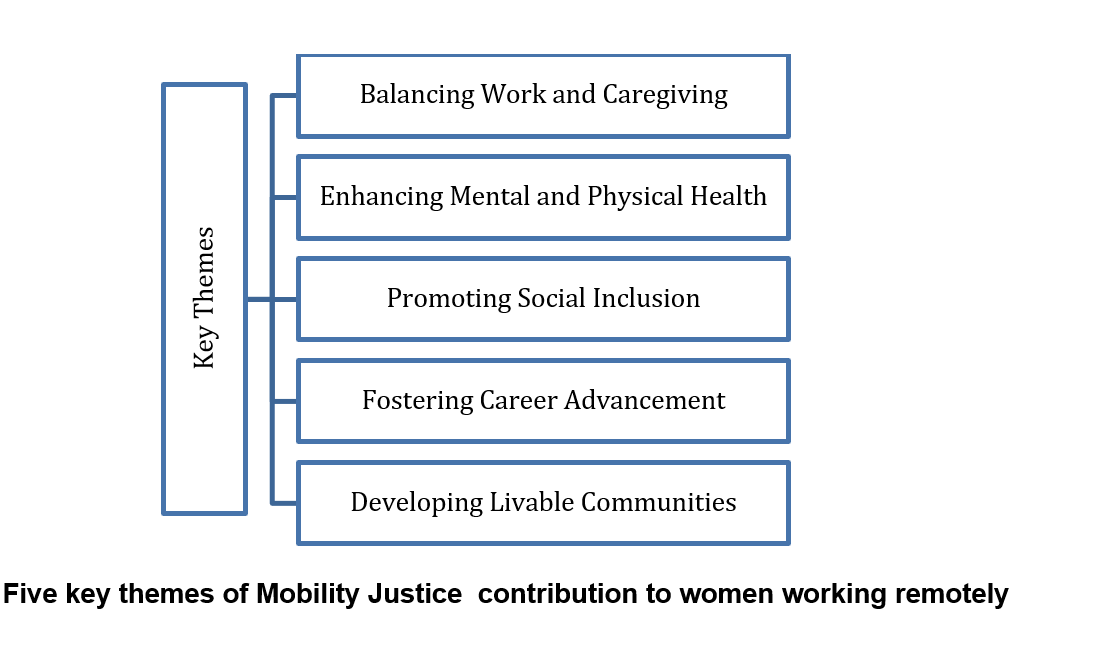
1. Concluding five key themes that reflect the mobility justice role in fulfilling remote working women’s needs, particularly those balancing caregiving responsibilities and career advancement.
2. Highlighting the ongoing shift towards a new paradigm of urban development, where cities are changing to accommodate the diverse needs of remote workers.
Impacts for city policy and practice
The study has implications in urban planning and policymaking to prioritize mobility justice in urban development strategies. This includes guiding existing and newly developed residential neighborhoods for equitable and inclusive environments that consider diverse populations’ needs in mobility. Urban developers should consider creating walkable environments that provide equal access opportunities for social events, physical activities, and essential services for women working remotely. Instead of building more office districts, and longer daily commutes to work, urban planners should prioritize livable communities.
Further information
Full research article:
Mobility justice for remote-working women by Alshimaa Aboelmakarem Farag
Related posts

Shared mobility hubs that offer (electric) bikes and cars can be a sustainable solution that enables people to expand their mobility options while protecting cities’ environment by reducing private car use and encouraging cycling. We interviewed residents of a deprived neighbourhood in Utrecht, the Netherlands, to understand their mobility needs and views on a recently implemented shared mobility hub in their neighbourhood, identifying potential obstacles in the process.

We examine how caregiving-related needs remain overlooked in walkability and Transit-Oriented Development strategies. Despite high levels of urban complexity, many transit-accessible areas lack essential caregiving-support places, particularly in vulnerable neighbourhoods. This spatial mismatch limits care-engaged individuals’ ability to chain trips, and access services, reinforcing mobility and social inequities. Our research highlights the need to integrate caregiving accessibility into planning frameworks to ensure that walkable cities are also inclusive and care-supportive.

The world is currently responding to the climate crisis and the nature crisis as if they were separate challenges. This is a dangerous mistake. The are leading to dire impacts for our health