City Know-hows

30 km/h streets promote more active and socially connected streets: evidence from Amsterdam

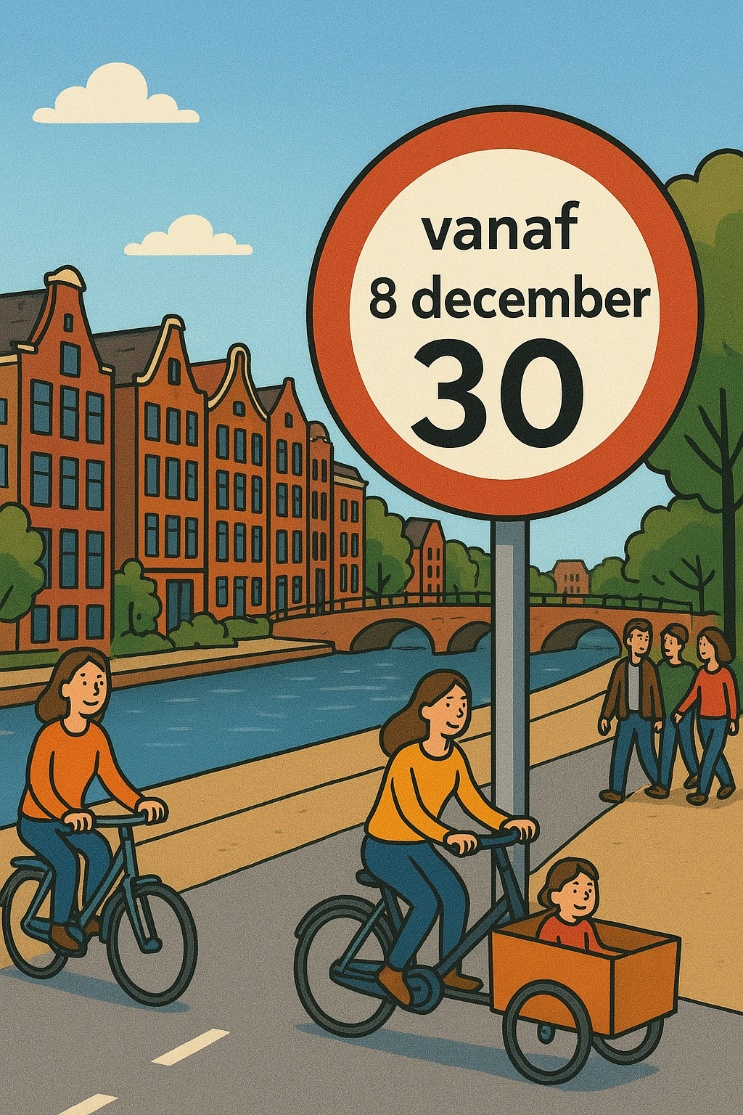
Cartoon illustration of the 30 km/h speed limit scheme in Amsterdam. Image generated by ChatGPT (OpenAI, 2025).

When cities reduce traffic speeds, people move and connect more. Amsterdam’s city-wide 30 km/h limit increased children cycling by 86% and social interactions among adults by 75% on intervention streets, showing that speed limits can shape healthier, more connected cities.

Share

Target audience

City transport officers, urban planners, and public health policymakers.

The problem

High vehicle speeds make streets unsafe, noisy, and uninviting, discouraging walking, cycling, and social activity. While 30 km/h limits are increasingly adopted across European cities, robust evidence on their broader public health impacts is limited. Policymakers often rely solely on road safety statistics, missing potential wider benefits such as promoting physical activity and fostering social interactions. Without robust real-world evidence, cities cannot confidently implement speed limits as a tool for healthier, more liveable streets.

What we did and why

We conducted a natural experimental study of Amsterdam’s city-wide 30 km/h policy. Using systematic street observations over a one-year period, we compared physical activity, child safety behaviours, and social interactions between intervention streets (changed from 50km/h to 30 km/h) and control streets (remained 50 km/h). Leveraging this real-world policy change allowed us to generate rare, real-world evidence on how lowering traffic speeds can help cities promote physical activity and social connection.

Our study’s contribution

Our study provides strong evidence that 30 km/h limits yield benefits beyond road safety. Key findings include:
• Children cycling increased.
• Adults were more likely to be in groups and engage in conversation.
• Teens were less likely to be observed alone, while younger children were more frequently observed alone.
Together, these results suggest that lower speed limits could promote active travel, support children’s independent mobility, and enhance social interactions.

Impacts for city policy and practice

Our findings suggest 30 km/h limits are a low-cost, scalable intervention to generate measurable public health and liveability benefits. These findings enable policymakers to position speed limit policies not only as safety measures, but as an intervention to foster independent child mobility and neighbourhood cohesion, advancing the Sustainable Development Goals for inclusive and connected cities.

Further information

Full research article:

[OPEN ACCESS] Impacts of a city-wide 30 km/h speed limit intervention on physical activity, child safety and social behaviours: a natural experimental study in Amsterdam, the Netherlands by Jack S. Benton, Carel-Peter L. van Erpecum, Famke J. M. Mölenberg, Anna Bornioli, Roosmarijne Kox, Tessa de Ruiter, Birgit I. Lissenberg-Witte, and Nicolette R. den Braver.

Related posts

Perceptions of design professionals regarding vertical greenery in buildings – A case of Delhi

Our study provides valuable insights by examining the obstacles and viewpoints regarding vertical greenery systems in Delhi. It highlights the technical challenges as significant adoption barriers among built environment professionals. Emphasizing the pivotal role of vertical greenery in climate change mitigation, this research advocates for further scholarly investigation and evidence-based policy formulation. This deepened understanding supports the seamless integration of vertical greenery systems into urban landscapes, fostering sustainability and resilience.

Read More »

Can child-friendly walkability be improved in a two-wheel traffic-saturated city like Ho Chi Minh City, Vietnam?

Ho Chi Minh City’s motorbike-dependent traffic, severe congestion from overloaded infrastructure, high accident rates among children and pedestrians, and a doubling of overweight and obesity rates among children over the past decade have driven a comprehensive study on children’s walkability. This study serves as a foundation to encourage more walking among children as an initial step toward addressing these critical issues.

Read More »