
City Know-hows
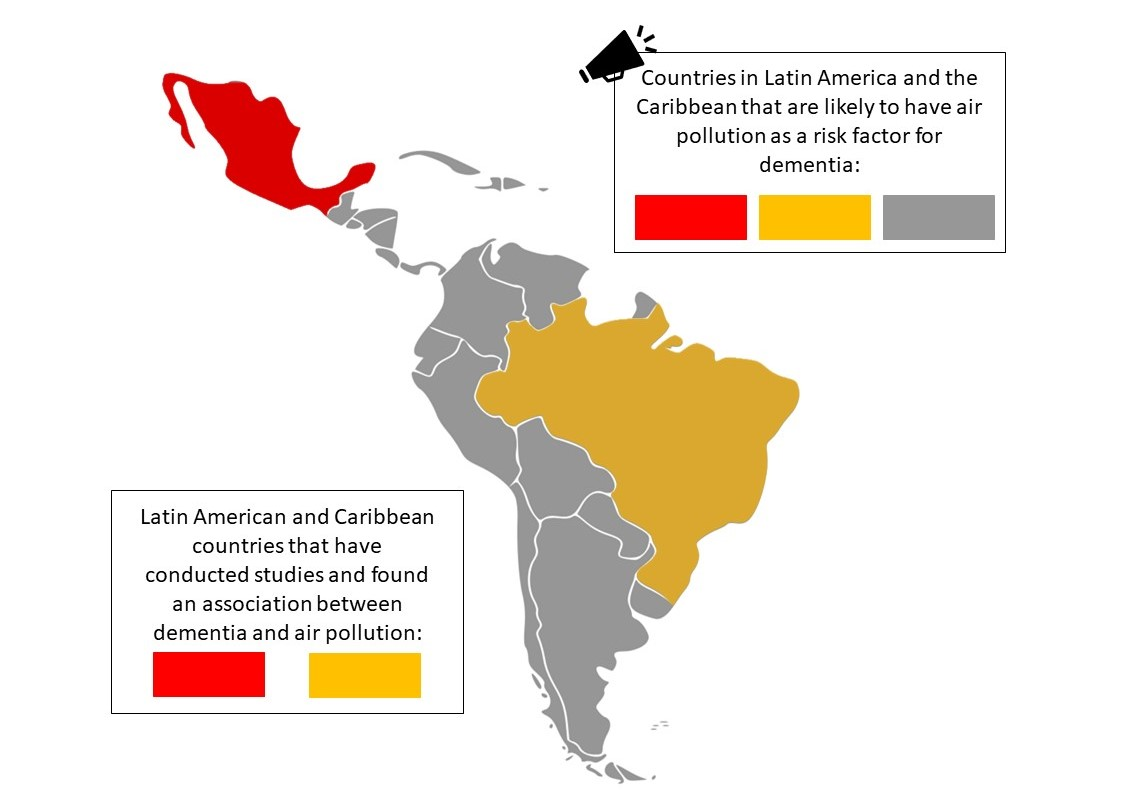
Air pollution is linked to a high risk of dementia. However, it is concerning that only two Latin American countries are studying this association.
Share
Target audience
Governors and citizens of the countries that make up Latin America and the Caribbean, as well as the neuroscience community.
The problem
Studies have been conducted in European and North American countries that indicate that there is a positive relationship between exposure to air pollutants and an increase in cases of dementia, but it is not clear whether this association also exists in Latin American and Caribbean countries, where the sociodemographic characteristics are different.
What we did and why
We conducted a search of all studies that have been conducted worldwide where there was an association between air pollution and dementia. Of these, we selected only those that were conducted in countries or cities in Latin America and the Caribbean. We wanted to establish whether the association has been described in this area of the world, how often it has been done and what policies have been generated from it to intervene.
Our study’s contribution
We found that the evidence that air pollution is a risk factor for dementia was reinforced; however,
Impacts for city policy and practice
There is a need to have clear levels of air pollution in all Latin American cities. All relevant authorities, stakeholders, and actors must seek mitigation strategies to reduce the deterioration of cognition of its inhabitants indirectly through air pollution. If this risk factor for dementia is diminished, it can reduce costs to the health system in the future.
For more information on the global air pollution and dementia situation, see The Barcelona Institute for Global Health – Air Pollution and Dementia blog.
Further information
Full research article:
Air pollution and cognitive impairment among middle-aged and older adults in Latin America and the Caribbean: a scoping review by Ana María Baldovino Chiquillo, Kelly Yohana Moreno Bocanegra & Daniel Hedmont Rojas.
Related posts

Australian pilot study finds a Healthy Urban Transition Tool can assess the liveability of urban environments and assist in transitioning neighborhoods towards improving the social determinants of health and health equity.

Differences in walking behaviour among racial groups highlight systemic inequalities that affect how and why people walk, pointing to broader issues of transportation and urban planning inequities.

Implementing community participation in planning of public open spaces is one of the most useful and effective means to encourage a higher sense of community.