City Know-hows

Bridging the gap: A study of pedestrian mobility, conflicts, and climate in enhancing continuous movement on sidewalk

Uninterrupted pedestrian flow is key to walkable, inclusive cities. This study explores how sidewalk conditions, user conflicts, and weather disruptions affect movement. By identifying key qualitative factors, we propose a user-focused method for assessing and enhancing sidewalk Quality of Service (QoS).

Share

Target audience

• Urban Planners and Municipal Authorities – To apply the study’s findings in real-world infrastructure projects, improving pedestrian experiences in cities worldwide.
• Transportation and Mobility Agencies – Integrating pedestrian-friendly policies into broader urban transport frameworks, particularly in rapidly urbanizing regions.
• Policy Makers and Government Bodies – To prioritize funding and regulatory changes that support inclusive, walkable urban environments.
• International Development Organizations (e.g., UN-Habitat, World Bank, Asian Development Bank) – To leverage the research in global initiatives aimed at sustainable, inclusive urban development.
• Architects and Urban Designers – To consider pedestrian continuity and comfort when designing public spaces, streetscapes, and urban renewal projects.
• Advocacy groups and NGOs – especially those focused on disability rights, senior citizens, and environmental sustainability- should use the research to lobby for better sidewalk infrastructure.
• Smart City and Tech Developers – To inform pedestrian-centric innovations in mobility apps, smart infrastructure, and data-driven city planning tools.
• Educational and Training Institutions – For incorporating real-world, interdisciplinary challenges into urban design, architecture, and planning curricula.

The problem

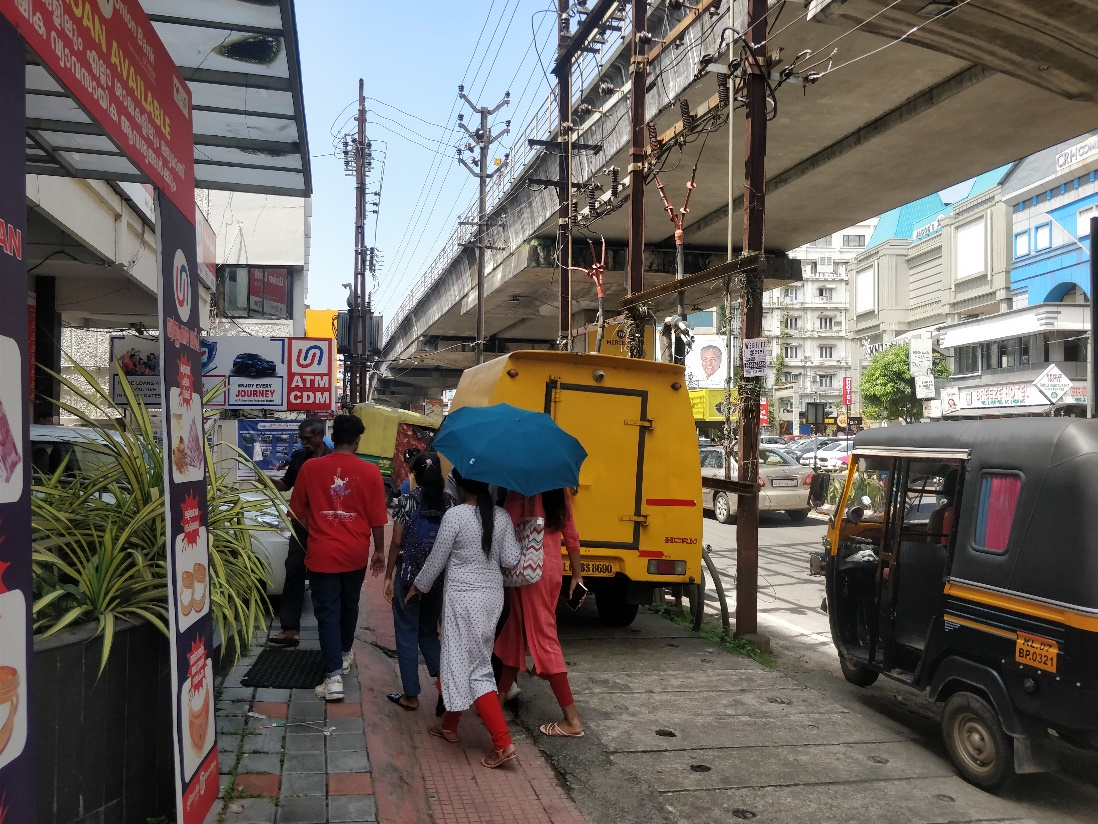
In dense, developed urban areas, pedestrian movement is often disrupted by physical obstacles, poor infrastructure, user conflicts, and adverse weather. These issues reduce comfort, safety, and accessibility, especially for vulnerable groups like the elderly and people with disabilities. Although walkability is gaining attention, continuous pedestrian movement remains underexplored. Addressing continuous pedestrian movement is essential for ensuring seamless, user-friendly walking environments that support diverse needs and promote more inclusive, accessible, and sustainable urban mobility systems worldwide.

What we did and why

To address the gap in pedestrian infrastructure analysis, we explored factors disrupting continuous pedestrian movement along sidewalks. We categorized these into three key areas: mobility on sidewalks, pedestrian conflicts, and climatic conditions. Each includes qualitative elements like obstructions, user interactions, and environmental discomfort. Our goal was to develop a user-centric framework that identifies and connects these parameters, allowing for more meaningful evaluations of pedestrian infrastructure and enhancing the overall sidewalk experience for diverse user groups.

Our study’s contribution

We introduce a new qualitative framework for evaluating pedestrian infrastructure, focusing on user experience. This:
• Identifies and categorizes key disruptions of factors affecting continuous pedestrian movement (CpM).
• Proposes a holistic approach to assessing sidewalk Quality of Service (QoS).
• Notes interconnected physical, social, and environmental influences on pedestrian experience.
• Supports the prioritization of vulnerable users’ needs, making urban spaces more accessible, comfortable, and walkable.

Impacts for city policy and practice

Our research provides practical insights for urban policymakers, planners, and transportation authorities to help cities identify and address factors disrupting continuous pedestrian movement. Our findings:
• Enable informed decision-making on sidewalk design, maintenance, and regulation.
• Promote inclusive public spaces that serve all demographics, including vulnerable populations.
• Enhance urban walkability and encourage active transportation.
• Align with global sustainability goals and supports people-centred urban development.

Further information

Full research article:

Sidewalk quality assessment using continuous pedestrian movement factors by Sangeeth K & Uttam Kumar Roy

Related posts

Public life in Tehran, during and after the pandemic

Our work shows the suitability of using Gehl and Svarre methods even during unexpected situations like the pandemic to study public life. Furthermore, the results provide a comprehensive view of public life in Tehran which has not been done before. This study shows the importance of plazas and urban green spaces during the pandemic for maintaining the public life and people’s physical activity.

Read More »