

City Know-hows
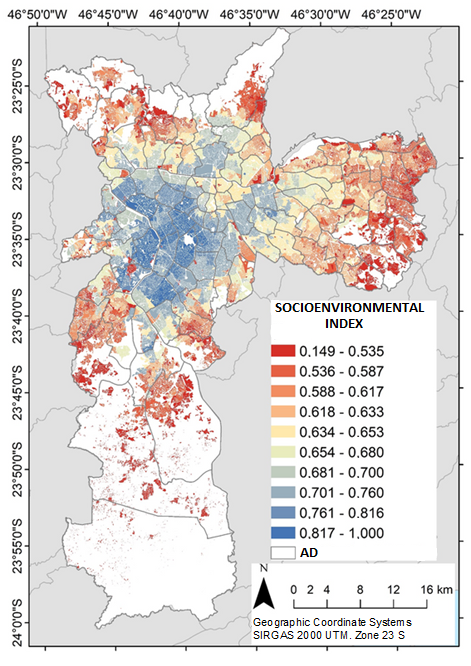
Monitoring slum health through ecological deprivation indexes is a useful strategy to understand and reduce health inequalities within a city. We developed a robust socioenvironmental index capable of explaining health outcomes in small intraurban areas and differentiating areas with the presence of different slum typologies and non-slum spaces.
Share
Target audience
Urban planners and public health practitioners.
The problem
Ecological multidimensional deprivation indexes help to identify the underlying mechanisms of health inequalities. Unfortunately, most approaches in health research use a single geographic variable as a proxy for deprivation or socioeconomic status (e.g., median household income) and the environmental context has been commonly neglected. Furthermore, there is a lack of data for small areas that delays the understanding of the relationship between health and deprivation of vulnerable communities within a city.
What we did and why
Guided by theoretical references on health, we developed the robust Socio-environmental Deprivation Index (SeDI) for the Municipality of São Paulo, Brazil. SeDI was developed through Principal Component Analysis. By using spatial regression models, with the SeDI as the predictor, we explained around 60% or more of the ageing rate in small areas of the city. Additionally, we found significant statistical differences between the index scores of different municipal slum typologies and non-slum areas.
Our study’s contribution
Our approach brings many advantages for health studies, such as:
Besides the often employed area-level socioeconomic measures, we found that variables of the surrounding environment greatly contributed to explaining health outcomes.
Impacts for city policy and practice
Our Socio-environmental Deprivation Index (SeDI) approach can help to leverage social mobility and improve health in deprived urban settlements. It can be a useful tool for developing multiscale studies, which commonly lack data for small areas. Our methodology can be easily replicated for other Brazilian metropolitan areas and other countries with comparable situations. It can guide the development of indexes for health studies in small areas of megacities with high levels of inequality. Lastly, our Socio-environmental Deprivation Index’s dimensions can help to compare different aspects of deprivation worldwide.
Further information
Full research article:
A Socioenvironmental Deprivation Index for slum health research in the municipality of São Paulo, Brazil by Mirela Barros Serafim, Paula Santana, Alessandra Cristina Corsi & Ligia Vizeu Barrozo.
Related posts

As urbanisation continues globally, the interest in urban green space as a provider/supporter of mental well-being is still growing. The question has largely moved on from “Will a walk in the park help with mental well-being?” to “Will a walk in any park do?” Previous research suggested that urban green spaces with rich fauna and flora (i.e. rich biodiversity) improved mental well-being. However, the experimental evidence remains limited.

Our study sheds light on the evolving dynamics of the Greater Cairo Region, adding depth to the understanding of whether gated communities act as true remedies or reflections of concrete houses. By incorporating a model based on critical factors for mental health, we offer insights into the nuanced dimensions of well-being in the context of urban development. This research contributes to a more comprehensive understanding of the complex interplay between city structure and residents’ overall well-being.

Air pollution kills. But who is most exposed to air pollution in a city? This paper explores how different workers in Bangkok are exposed to PM2.5, how they protect themselves (or not), and what this means for city planners.