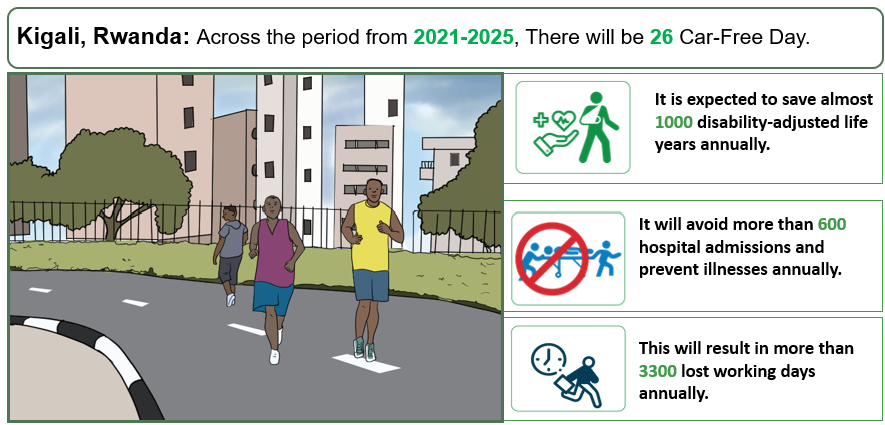
The health impact of non-motorized transport events in Kigali, known as ‘Car-Free Days,’ goes beyond just mass physical exercise. Importantly, it has reduced air pollution by 15%, this is expected to save more than 200 disability-adjusted life years annually.

Share

Target audience

City councils, epidemiologists, transport sector, communities.

The problem

Fast-growing cities and rising traffic congestion lead to declining air quality in Sub-Saharan Africa. This will also lead to declining growth in fuel imports, congestion, vehicle collisions, and GHG emissions. Due to the lack of data, evidence of transport and air pollution impact from Sub-Saharan contexts such as Rwanda is lacking. However, it is very valuable to understand traffic as a source of air pollution.

What we did and why

A lack of long-term air quality monitoring data in African countries such as Rwanda poses a significant challenge as urbanization and economic development lead to declining air quality. To understand the current drivers of air pollution, we used two natural experiments (Car-Free Day and COVID-19 Lockdown) to examine their impact on air pollution using particulate matter air pollution data in Kigali City. We also quantify the benefits of reduced air pollution.

Our study’s contribution

We found clear evidence that the transport sector is a major contributor to urban air quality in Kigali.
• Using the COVID-19 lockdown, we find that reduced travel activity of over 80% led to PM2.5 levels declining by 33%.
• We also found that a program to encourage non-motorized transport in Kigali called ‘Car-Free Days’ reduced PM2.5 by 15%.
• This reduction is expected to have resulted in more than 200 disability-adjusted life years saved in Kigali annually.

Impacts for city policy and practice

We provided policies for the City of Kigali to consider in order to improve air quality and overall public health;
• Prioritise public transport,
• Facilitate transport sector data sharing to support planning, coordination, and research,
• Focus on vehicle maintenance, testing and enforcing vehicle standards,
• Ban engine idling,
• Invest and promote e-mobility transport,
• Develop a framework for using carbon credits to stimulate finance for e-mobility firms without double-counting emissions.

Further information

Full research article:

[OPEN ACCESS] Natural experiments in urban air quality: lessons from car-free days and COVID-19 lockdowns in Kigali, Rwanda by Egide Kalisa, Andrew Sudmant, Remy Ruberambuga & Jonathan Bower.

Related posts

Facilitating adaptation action: Interactive diagrams to support understanding and action on climate change 

Climate change influences everybody in every sector. We gathered available evidence on the impacts of climate change and potential adaptations now and in the future in the UK. From this review, we developed systems diagrams that visualise the evidence in an accessible and interactive manner to facilitate the climate change planning process. These diagrams are part of the Local Climate Adaptation Tool (LCAT) which was co-produced with Cornwall Council and a National Stakeholder Group of local decision-makers. New interactive diagrams have been produced to show how and where climate change impacts occur, why they are interconnected, and their consequences on human health and wellbeing. These diagrams are part of the Local Climate Adaptation Tool (LCAT). 

Read More »