
City Know-hows
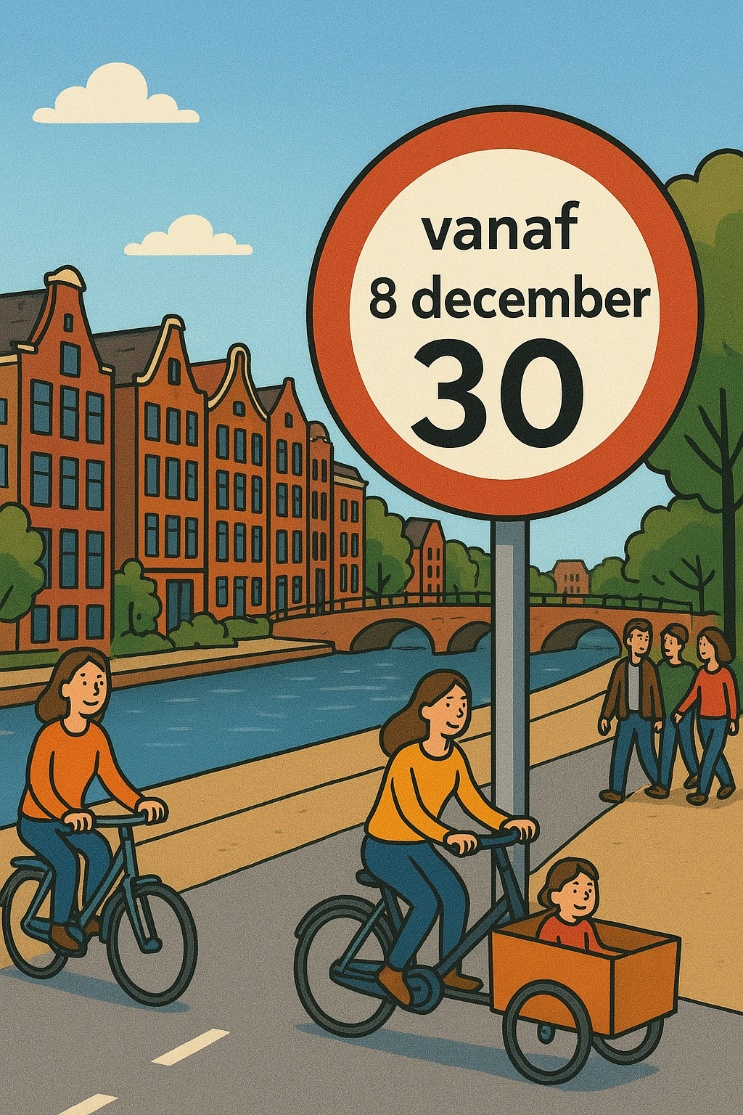
When cities reduce traffic speeds, people move and connect more. Amsterdam’s city-wide 30 km/h limit increased children cycling by 86% and social interactions among adults by 75% on intervention streets, showing that speed limits can shape healthier, more connected cities.
Share
Target audience
City transport officers, urban planners, and public health policymakers.
The problem
High vehicle speeds make streets unsafe, noisy, and uninviting, discouraging walking, cycling, and social activity. While 30 km/h limits are increasingly adopted across European cities, robust evidence on their broader public health impacts is limited. Policymakers often rely solely on road safety statistics, missing potential wider benefits such as promoting physical activity and fostering social interactions. Without robust real-world evidence, cities cannot confidently implement speed limits as a tool for healthier, more liveable streets.
What we did and why
We conducted a natural experimental study of Amsterdam’s city-wide 30 km/h policy. Using systematic street observations over a one-year period, we compared physical activity, child safety behaviours, and social interactions between intervention streets (changed from 50km/h to 30 km/h) and control streets (remained 50 km/h). Leveraging this real-world policy change allowed us to generate rare, real-world evidence on how lowering traffic speeds can help cities promote physical activity and social connection.
Our study’s contribution
Our study provides strong evidence that 30 km/h limits yield benefits beyond road safety. Key findings include:
• Children cycling increased.
• Adults were more likely to be in groups and engage in conversation.
• Teens were less likely to be observed alone, while younger children were more frequently observed alone.
Together, these results suggest that lower speed limits could promote active travel, support children’s independent mobility, and enhance social interactions.
Impacts for city policy and practice
Our findings suggest 30 km/h limits are a low-cost, scalable intervention to generate measurable public health and liveability benefits. These findings enable policymakers to position speed limit policies not only as safety measures, but as an intervention to foster independent child mobility and neighbourhood cohesion, advancing the Sustainable Development Goals for inclusive and connected cities.
Further information
Full research article:
[OPEN ACCESS] Impacts of a city-wide 30 km/h speed limit intervention on physical activity, child safety and social behaviours: a natural experimental study in Amsterdam, the Netherlands by Jack S. Benton, Carel-Peter L. van Erpecum, Famke J. M. Mölenberg, Anna Bornioli, Roosmarijne Kox, Tessa de Ruiter, Birgit I. Lissenberg-Witte, and Nicolette R. den Braver.
Related posts

Our study focuses on active and independent mobility of children in a car-free settlement which can be promising for developing policies for a child-friendly urban future and mobility justice for children. The outputs of this study can bridge the gap between vehicle-oriented and non-vehicle-oriented settlements and enable the transfer of good experiences.

Mobility justice can help ensure that remote-working women have equal access to transportation and urban amenities, supporting their well-being and career advancement. This research explores the unique mobility needs of this growing population and recommends planning strategies to create more inclusive and equitable cities.

This study addresses the need for a more nuanced understanding of how urban design influences people’s walking habits in the Global South through case studies in Indonesia. Understanding the intriguing relationship between the built environment, personal perception, and walking behaviour is critical for designing more walkable, healthy, and sustainable cities.