City Know-hows
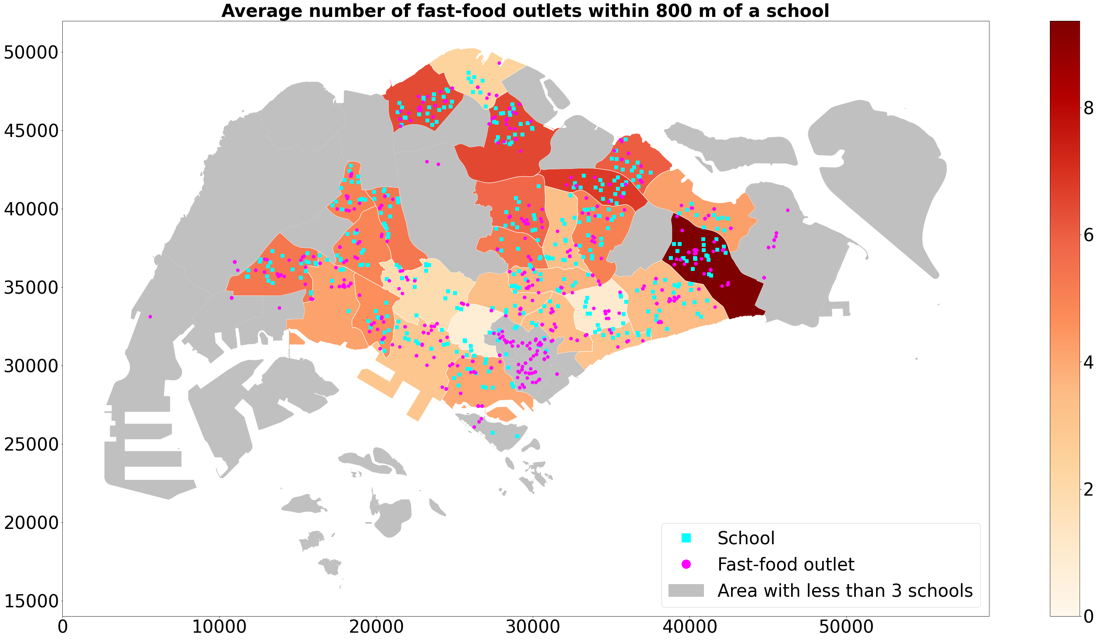
Most schools in Singapore are exposed to fast-food outlets within walking distance, with closer proximity in lower-income areas and strong contrast between public and international schools. This clustering poses public health risks and highlights the urgent need for urban planning strategies to create healthier school neighbourhoods.
Share
Target audience
City planners, policymakers, and urban health advocates.
The problem
Childhood obesity is a growing concern globally, influenced not only by individual choices but also by the environments in which children live and learn. In dense urban settings like Singapore, the widespread availability of fast-food outlets near schools may expose children to unhealthy food options daily. We investigate the spatial clustering of fast-food outlets around schools across Singapore, focusing on how the pattern varies by neighbourhood income and school type, revealing significant socio-spatial health inequalities.
What we did and why
We conducted an ecological study to examine the proximity and clustering of fast-food outlets around schools across planning areas in Singapore. Using cross-sectional data from government sources and official fast-food directories, we analysed spatial patterns by school type and neighbourhood income. Multivariate regression models were used to assess associations while adjusting for transport access, population density, and income. Our goal was to understand how urban food environments may contribute to health inequalities and inform planning policies.
Our study’s contribution
This study provides empirical evidence on the spatial clustering of fast-food outlets around schools in a dense urban setting, highlighting socio-spatial inequalities in food access. We show that fast-food outlets are more concentrated near public schools and in lower-income neighbourhoods, raising concerns about obesogenic environments. By linking urban form, school location, and food accessibility, the findings offer valuable insights for urban planners, public health practitioners, and policymakers aiming to create healthier, more equitable school neighbourhoods.
Impacts for city policy and practice
The findings highlight a critical need for policies that address the external food environments around schools. Urban planning regulations could consider zoning restrictions or buffer zones limiting fast-food outlet density near schools, particularly in lower-income neighbourhoods. Integrating health equity into land-use planning and licensing decisions can help mitigate obesogenic environments. Collaborative efforts between planning authorities, public health agencies, and education sectors are essential to create supportive environments that promote healthier food choices for children and families.
Further information
Full research article:
Examining the built food environment: proximity of fast-food outlets to schools in a high-density urban context by Alexander Mok, Aimee E. Pink, Florence Sheen & Hoai Nguyen Huynh.
Related posts

Lack of ‘Ciclorutas’ (bicycle lanes) in Bogota’s neighbourhoods of low socio-economic status shows inequality in the access to active transportation options, potentially increasing health disparities.

Despite historic disinvestment and stigmatizing portrayals of public housing, residents often describe their place as a source of refuge. We explored the ways residents of a predominately Black public housing complex undergoing redevelopment construct meanings of place, emphasizing their place-making efforts to challenge their social marginalization and foster community health.

The world is currently responding to the climate crisis and the nature crisis as if they were separate challenges. This is a dangerous mistake. The are leading to dire impacts for our health