City Know-hows
Can Bangkok truly clean its air? New initiatives show promise, but key changes are needed. This analysis reveals how better infrastructure, stronger governance, and embracing renewable energy can pave the way for a healthier city.
Share
Target audience
General public, policy makers and urban planners.
The problem
Bangkok’s struggle with air pollution persists despite well-intentioned policies. The core problem lies in the gap between policy and practice. While initiatives like the EV3.5 scheme and new emission standards show commitment, inadequate infrastructure, such as limited EV charging stations and reliance on natural gas, hinders their effectiveness. Weak enforcement and fragmented governance further complicate efforts. This disconnect between policy and implementation prevents Bangkok from fully realizing its clean air goals, impacting public health and the city’s long-term sustainability.
What we did and why
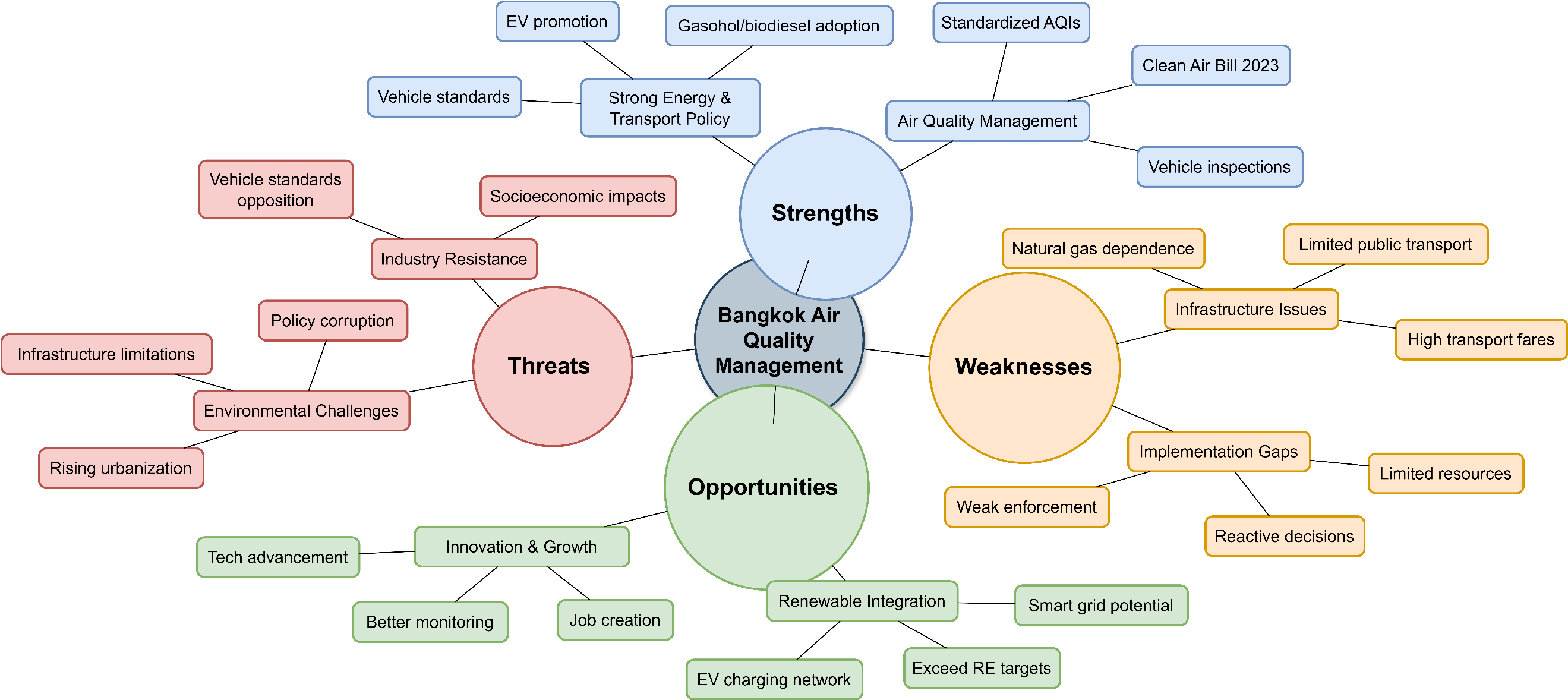
To understand how Bangkok can effectively combat air pollution, we conducted a comprehensive analysis of its current strategies. This involved examining existing policies, infrastructure, and governance structures. By identifying strengths, weaknesses, opportunities, and threats (a SWOT analysis), we aimed to pinpoint critical areas needing immediate attention. This approach allows for a data-driven assessment, providing actionable insights into bridging the gap between policy and practice for a cleaner, healthier Bangkok.
Our study’s contribution
This study provides a practical roadmap for improving Bangkok’s air quality. It goes beyond simply acknowledging the problem by offering concrete, actionable recommendations. By highlighting the crucial need to strengthen infrastructure, enhance governance, and embrace sustainable energy solutions, this analysis offers a clear path forward. It also emphasizes the importance of balancing short-term economic considerations with long-term environmental sustainability, providing a valuable framework for other rapidly urbanizing cities in Southeast Asia facing similar challenges.
Impacts for city policy and practice
This study has significant implications for Bangkok’s air pollution strategy. It underscores the need for integrated planning, focusing on developing robust EV charging infrastructure and transitioning to renewable energy sources. Strengthening inter-agency coordination and enforcement mechanisms is crucial. Prioritizing public-private partnerships can accelerate infrastructure development. Finally, fostering regional cooperation on transboundary pollution and supporting community-based initiatives will enhance the effectiveness of city-level interventions, leading to tangible improvements in air quality.
Further information
Full research article:
From policy to practice: a SWOT analysis of air pollution control strategies for a sustainable Bangkok Metropolitan area by Yacob T. Tesfaldet & Penradee Chanpiwat.
Related posts

How does everyday mobility shape local social cohesion in cities? Our study shows that walking and cycling in the neighborhood create spontaneous, low-threshold encounters – and that these everyday interactions are vital for building healthier, more connected urban communities.

Caste and environment intersect to shape urban health inequities in Indian cities. Based on fieldwork in Aligarh, this study uncovers how lower-caste households are disproportionately exposed to environmental hazards and denied equitable healthcare. I conducted a mixed-methods study of 1,650 households in Aligarh to examine the relationship between caste, environmental conditions, and health. Using correlation analysis and spatial mapping, I identified patterns of environmental risk and unequal access to healthcare services. The findings urge inclusive urban health planning that prioritizes caste-aware environmental justice.

Play streets are gaining popularity around the world. In French cities, more and more residents and local associations wish to develop play streets. One-off play streets are especially popular to introduce residents to the concept of a play street. However, there is little research outlining the key contextual elements for developing long-term or recurring play streets; these confront different obstacles than one-off play streets and require different efforts from those developing the play street.