
City Know-hows

Designing healthier neighborhoods: The importance of proximity to daily destinations in shaping health outcomes

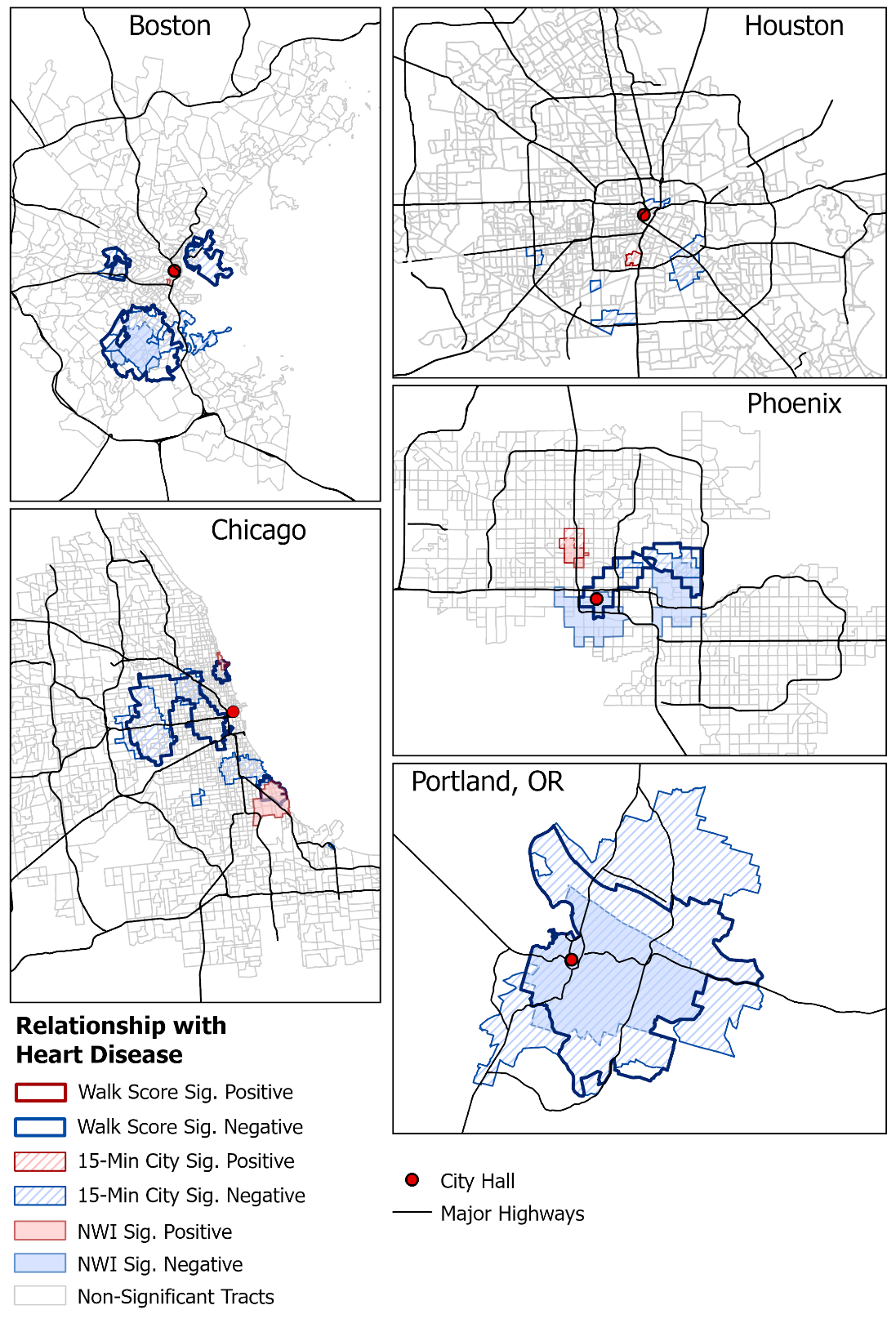
Results of the geographically weighted regression analysis indicating where statistically significant positive (red) and negative (blue) associations were observed between accessibility/walkability and coronary heart disease.

We tested whether living closer to daily destinations is associated with improved health across major U.S. cities. Neighborhoods with stronger 15-minute accessibility consistently showed lower rates of chronic disease, suggesting that planning for proximity might support healthier urban living.

Share

Target audience

City planners, public health officials, and metropolitan/regional policy leaders responsible for land use, transportation, and community health strategies.

The problem

Chronic diseases such as heart disease remain unevenly distributed across urban neighborhoods. Built-environment features like walkability and access to services are known to influence physical activity and long-term health. Widely used walkability metrics capture density, land-use mix, or connectivity but may overlook whether residents can realistically reach daily needs within a short walk or bike trip. This gap may limit the effectiveness of health-oriented planning.

What we did and why

We compared three common measures of neighborhood accessibility and walkability across five large U.S. metropolitan areas and multiple chronic disease outcomes to determine whether proximity-based planning provides guidance for improving public health rather than density-based or spatial form-based indicators.

Our study’s contribution

We found that the 15-minute city index and Walk Score were the most consistent predictors of neighborhood health, while the National Walkability Index showed weaker and less stable relationships. Greater proximity to daily destinations was generally associated with lower modelled prevalence of heart disease, obesity, and diabetes across metropolitan areas.

Impacts for city policy and practice

Our findings suggest health-focused planning should prioritize improving access to essential daily destinations rather than relying only on density or land-use mix. Location-specific strategies are critical because accessibility–health relationships differed among metropolitan areas with varying urban morphologies.

Further information

Full research article:

Related posts

The Emerald Isle or a Green Desert? Gardens as sites for city greening 

To create cities where both nature and humans thrive, the research outlines how city gardens are interconnected with the surrounding countryside and coast. A hands-on approach is needed to bring more nature into gardens through combining disciplines such as 1) environmental psychologists (unearthing different types of gardeners) 2) the horticultural industry (the know-how) and 3) the marketing/advertising industry (the storytellers). Aggregated actions of domestic gardeners could help policy-makers push for improved biodiversity restoration.

Read More »

Bridging mobility and equity: Rethinking safe routes to school in gentrifying communities

We investigated how Safe Routes to School (SRTS) programs intersect with gentrification in Greenville’s West End by using children’s active mobility as a lens to assess community perceptions. Through observations, behavior mapping, and interviews, we explored how mobility infrastructure impacts cultural traditions and socioeconomic dynamics. This approach allowed me to uncover tensions between design intentions and community realities, providing critical insights to guide equitable, context-sensitive urban planning in rapidly changing neighborhoods.

Read More »